Modern Bus Simulator: Bus Game
- 4.1
- Rating
- 100.00M
- Installs
- Free
- Price

 Analysis by App-foxy
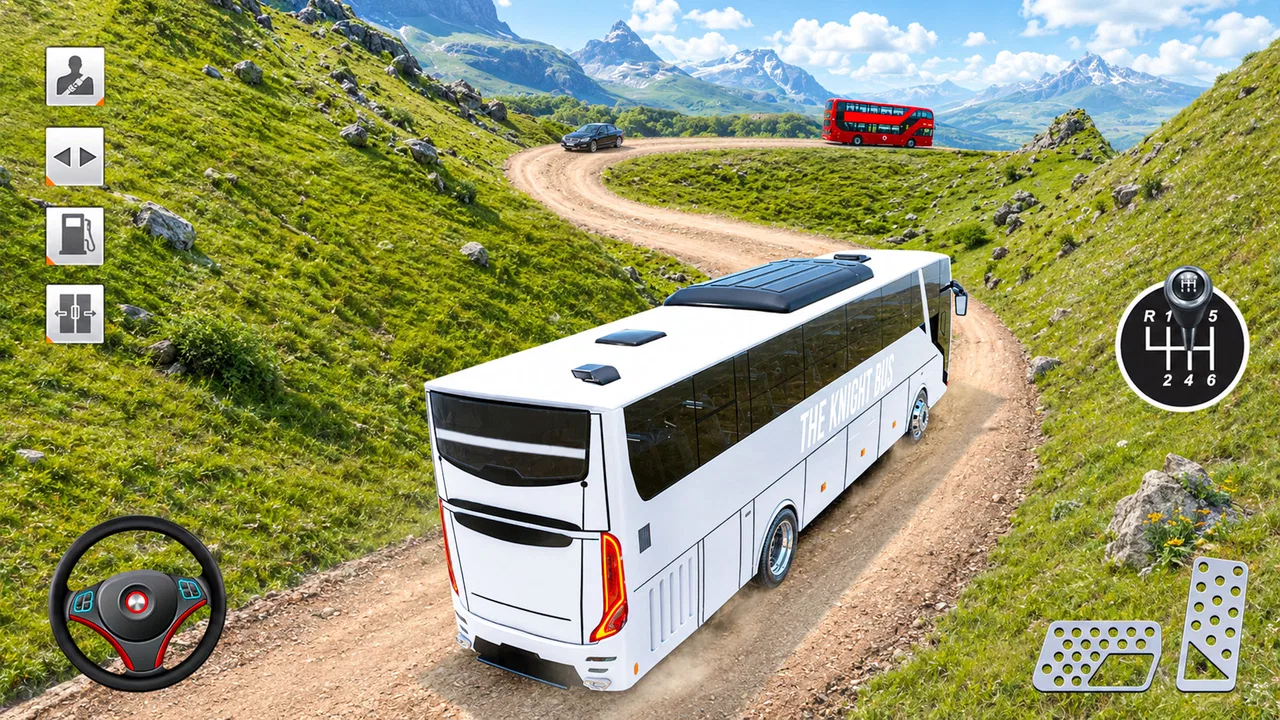
I approached Modern Bus Simulator: Bus Game as the sort of racing game that can sit on a shared phone and invite short turns rather than demanding a long, uninterrupted session. Its central idea is simple: take control of a bus, handle the road, and work on parking accurately. That sounds calmer than a typical racing title, but the larger vehicle makes small mistakes feel meaningful. A late turn, a clipped corner, or a rushed stop can turn an easy-looking route into a careful driving exercise.
In my experience, that makes it a useful choice for households where people want something approachable but still enjoy a little challenge. It is free to install, rated for Everyone, and developed by GAMEXIS. The game has reached over 100 million installs and holds a 4.1 average from around 171 thousand ratings, so it is clearly not an obscure experiment. I would not treat those figures as a guarantee that every player will enjoy it, but they do suggest that the basic bus-driving formula has broad appeal.
How it works when several people share one device
The most natural shared-device scenario is a quick handoff. One person drives a route or attempts a parking section, then passes the phone to someone else to try the same kind of task. That works better here than it would with a long story-driven game because the appeal is concentrated in steering, positioning, and completing the immediate driving objective. A younger player can enjoy simply moving the bus, while an older player may focus on taking cleaner corners and avoiding careless contact.
You May Also Like

 AccuWeather: Weather Radar
AccuWeather Review: A Quick, Clear Forecast for Everyday Decisions
For everyday plans, the best forecast is the one you can understand quickly. AccuWeather makes rain timing, radar, and local conditions easy to act on, with a few trade-offs.

 Hill Climb Racing
Why Hill Climb Racing Still Turns Crashes Into One More Run
A tiny car, a bumpy hill and one more upgrade: Hill Climb Racing keeps resurfacing because its simple chaos makes every near-miss feel personal.

 AliExpress - Shopping App
AliExpress Makes Global Shopping Feel Personal, but Shoppers Bear the Risk
AliExpress turns a global marketplace into a pocket-sized discovery engine. Its reach is useful, its shopping loop compelling, and its trade-offs easy to miss.

 Lords Mobile: Kingdom Wars
Lords Mobile Is a Kingdom-Building Routine, Not a Quick Match
A case-by-case verdict on the building, battles, device demands, and social commitments that make Lords Mobile rewarding for some players and exhausting for others.

 PDF Scanner app - TapScanner
TapScanner Makes Paperwork Easier to Capture, Check, and Share
TapScanner makes scanning with a phone feel less like a rescue operation and more like a dependable step in getting work done. Its capture tools are useful, though not flawless.

 Block Blast!
 Shows How Much a Puzzle Game Can Leave Out
A quiet grid game shows why puzzle players increasingly value instant clarity, repeatable skill and low-pressure play—and where the genre still needs to catch up.
More From Our News Desk
View All News


I found that the bus itself creates an easy conversation point. A child may want to drive quickly, while another family member may insist on slowing down before a turn. That difference becomes part of the fun, but it also reveals the game’s main lesson: a bus needs more planning than a small racing car. The front may appear clear while the rear swings toward an obstacle, and a turn that looks safe from one angle can become awkward when the vehicle’s length catches up.
For a shared phone, I recommend agreeing on a simple turn length before starting. Because the game is built around driving and parking, it is easy for one player to keep retrying a difficult maneuver while others wait. A short rotation keeps the experience social instead of turning it into a private practice session. It is also a practical way to compare approaches: one player can use a slower, wider turn, while another can test whether a tighter line saves time without losing control.
The strongest shared-use feature is not a special family tool; it is the immediate readability of the driving task. Someone watching can understand what went wrong without knowing the entire game. That makes it suitable for casual cooperation, advice from the passenger seat, and friendly competition over who can park more neatly.
What to expect before handing over the phone
The store summary describes six driving modes, which gives the game more variety than a single repeated parking exercise. I would approach those modes as different ways to practice control rather than assuming each one will feel like a completely separate game. The important distinction is whether you enjoy adjusting your driving style. Some players will appreciate changing the rhythm of a route; others may find that the underlying steering and parking loop remains familiar after several sessions.
That distinction matters in a household. If one person wants a relaxed vehicle game and another expects high-speed racing with constant overtaking, they may not agree about what makes a good session. This is still a racing-category game, but its satisfaction comes more from managing a large vehicle than from chasing the sensation of a sports car. I would recommend it to someone who likes control and positioning, not to a player looking for a deep competitive race ladder.
Before installing it on a shared device, I would also check the phone’s available space and make sure the operating system is compatible. The current version is 3.96.0 and requires Android 7.0 or later. Those details are especially relevant with an older family phone that is passed between people. A game can be appealing on paper yet frustrating if the device struggles with it or cannot run the required software version.
Keeping expectations clear around purchases
Although the game is free, it includes in-app purchases ranging from $0.99 to $19.99 per item. That is the detail I would discuss before allowing unsupervised use on a shared device. The important issue is not only the individual amount; it is that a child, guest, or another household member may not think about whose payment method is connected to the device.
I would establish a straightforward rule: play is allowed, but any purchase requires the owner’s permission first. That conversation is more useful than assuming everyone understands the difference between a free download and optional spending inside a game. It also prevents a small, impulsive decision from becoming a household argument later.
Because I cannot treat the free entry point as the whole cost of ownership, I would judge the game in two stages. First, see whether the driving feels enjoyable without spending anything. Then decide whether any optional item genuinely improves the experience for the person who plays. If the basic controls already provide enough entertainment, there is no reason to buy simply because an option appears on screen.
Setup, boundaries, and practical coordination
My preferred setup for this game is simple: install it on the device that will actually be used, open it once with the owner present, and explain who is allowed to play and who can approve purchases. I would avoid handing over a phone while someone is in a hurry, especially if the device is also used for messages, work, or school. A bus game can be casual, but the phone itself may contain much more important information.
That boundary is useful for adults sharing a tablet or phone as well. One person may want to play while another needs the device for navigation or communication. Since the game encourages attention to the road and parking task, it is better treated as a focused activity rather than something to operate while walking, traveling, or handling another responsibility. I would reserve it for a safe, stationary moment.
Coordination becomes easier when players decide what they are trying to improve. Instead of saying “drive better,” choose one target for the next attempt: approach the parking space more slowly, leave extra room on a turn, or stop correcting the steering too late. This turns a failed attempt into useful practice. It also helps younger players understand that success is not only about finishing quickly.
One non-obvious advantage of the bus format is that it exposes rushed habits. In a smaller racing game, a player can sometimes recover from aggressive steering because the vehicle feels nimble. Here, a hurried correction can make the whole vehicle harder to place. I found that watching someone else play can be almost as instructive as taking a turn, because the observer notices the rear clearance and the timing of the approach more easily than the person concentrating on the controls.
For that reason, I would use the game as a small coordination exercise between an adult and a child. Let the child choose the general approach, then ask questions instead of taking over: “Where will the back of the bus go?” or “Would slowing down give you more room?” This keeps the player involved and makes the game about judgment rather than simply following instructions.
Who will enjoy the driving model
The controls are best suited to players who like gradual correction. A bus rewards anticipation, and the parking focus gives every steering decision a visible consequence. If you enjoy lining up a vehicle carefully, the game can be satisfying even when the route itself is not especially dramatic. It offers a clear reason to replay a section: improve the approach, reduce the wobble, and finish with more confidence.
On the other hand, players who want instant acceleration, spectacular crashes, or a highly competitive head-to-head experience may lose interest. The vehicle’s size creates a slower, more deliberate rhythm. That is not a flaw in itself, but it means the game should be compared with driving and parking simulators rather than only with fast arcade racers.
I also would not choose it as the only game for a household that wants a broad variety of genres. Its identity is firmly tied to buses, steering, and parking. The six driving modes add room to change activities, but they do not transform it into a collection of unrelated games. It works best when the group already enjoys vehicle handling or wants a low-pressure challenge that can be understood quickly.
Age context and trust on a shared device
The Everyone content rating makes the game easier to consider for a mixed-age household, especially compared with racing titles built around aggressive combat or mature themes. Still, an age rating does not replace supervision around device use or purchases. I would explain the spending rule clearly, keep the device owner involved, and make sure younger players know that the game is for playtime rather than a reason to interrupt other people’s work.
Trust also includes accepting that different players will use the game differently. A child may enjoy experimenting with turns, while an adult may care about clean parking. Neither approach has to be treated as the correct one. The useful boundary is between playful experimentation and behavior that affects the shared device, such as changing settings without permission or attempting a purchase.
For families, I would frame the game as a supervised, turn-based activity rather than assume it provides built-in household management. The practical safeguards come from the people sharing the device: clear permission, a known rotation, and an agreement about when the phone is available. That approach is more reliable than expecting the game itself to coordinate every family situation.
How it compares with the usual racing alternatives
Compared with an arcade racing game, this title is less about speed and more about spatial awareness. You are not choosing it because a bus is the fastest vehicle on the road. You are choosing it because the bus makes ordinary driving tasks feel demanding. The trade-off is clear: you get a more patient challenge, but less of the instant excitement that comes from overtaking opponents or using dramatic power-ups.
Compared with a detailed driving simulator, it is easier to approach as a casual mobile game. I would expect a focused bus experience rather than the depth of a full desktop-style simulation. That makes it a better fit for short sessions and shared use, but a weaker choice for someone who wants extensive vehicle tuning, a highly realistic career structure, or a large set of technical driving options.
Compared with a parking-only game, the bus setting gives the task more context. You are not simply moving a generic car into a marked space; the larger vehicle changes how you plan the entry and exit. The compromise is that the same central skill remains important throughout: careful positioning. Players who dislike repeating alignment exercises may find the experience narrow, even with several driving modes available.
That is why my recommendation depends on the player’s definition of variety. If variety means switching between different ways to handle a bus, this game has a reasonable foundation. If variety means moving from racing to customization to competition to exploration, another racing title will probably be a better match.
Small techniques that make the game less frustrating
My first practical tip is to treat a parking attempt as two separate jobs: approach and placement. If the approach is poor, trying to fix everything inside the parking space usually creates more corrections than necessary. Set up earlier, reduce speed before the turn, and give the bus room to rotate. This is especially helpful for new players who instinctively steer only when the obstacle is already close.
Second, watch the rear of the vehicle rather than staring only at the front. The front tells you where the bus is heading, but the rear tells you whether the turn is actually safe. This is the kind of detail a generic racing description would not prepare you for, and it is one of the clearest ways to improve without spending money or relying on repeated guessing.
Third, use failed attempts as information about timing, not as a reason to make every next attempt more aggressive. A player who misses a space may think the solution is to turn earlier and faster. Sometimes the better answer is to slow down and begin the maneuver with more room. The game rewards a calmer adjustment more often than a dramatic one.
For shared play, I would add a fourth rule: the person watching should give one suggestion at a time. Several instructions at once can make a younger player nervous and can cause the driver to overcorrect. A single observation, followed by another attempt, creates a better learning loop and keeps the session friendly.
Performance, longevity, and the decision to install
The current release is version 3.96.0, and the game supports devices running Android 7.0 or newer. I would still judge the experience on the actual phone rather than assuming that an older compatible device will feel identical to a newer one. Bus games depend on responsive steering, so even a small delay can make parking feel unfair. If the controls do not respond comfortably, the game loses much of its appeal.
Its long-term value will depend on how much you enjoy refining the same type of skill. I can imagine returning to it when I want a focused driving break, especially if I am in the mood for parking rather than high-speed competition. I would be less likely to keep it as a permanent main game if I wanted constant progression, social competition, or a changing stream of challenges.
The title’s popularity is substantial, with more than 100 million installs, and the average rating is 4.1. Those numbers make it reasonable to try, but they should not override personal preference. A player who dislikes slower vehicle handling will not necessarily change their mind because many other people installed it. The free price makes testing that preference easy, provided the household keeps the in-app purchase boundary clear.
My household verdict is positive with conditions. I would recommend Modern Bus Simulator: Bus Game to families or friends who want a simple, Everyone-rated driving game that supports short turns, conversation, and gradual improvement. It is particularly good for showing how vehicle size changes steering decisions, and it gives observers a meaningful role because they can help judge space and timing.
I would skip it for anyone seeking a fast, competitive racer, a deep simulation, or a game built around extensive customization. I would also avoid treating it as an unattended activity on a shared device merely because the content rating is broad. With clear rules about turns, device access, and purchases, it becomes an enjoyable casual bus-driving challenge. Without those rules, the game itself may be fine while the shared-device experience becomes unnecessarily inconvenient.
Overall, I see it as a practical free entry point into bus driving on mobile: approachable enough for a quick family session, but demanding enough to reward patience. Its best moments come when a player stops rushing, reads the space around the vehicle, and completes a clean maneuver. That is a modest goal, but for the right household, it is exactly the kind of repeatable challenge that makes a racing game worth keeping.
FAQs for Modern Bus Simulator: Bus Game
01What are the system requirements for Modern Bus Simulator: Bus Game?
Modern Bus Simulator: Bus Game requires a device running Android 5.0 or later, or iOS 10.0 or newer. It is optimized for devices with at least 2GB of RAM to ensure smooth gameplay. Storage-wise, ensure you have about 500MB free to accommodate the game’s installation and updates.
02Does Modern Bus Simulator: Bus Game offer offline play?
Yes, Modern Bus Simulator: Bus Game can be played offline. However, certain features like leaderboards and daily challenges require an internet connection. Playing offline allows you to enjoy the core gameplay, but connecting online enhances the experience with additional content and updates.
03Are there in-app purchases in Modern Bus Simulator: Bus Game?
Modern Bus Simulator: Bus Game does include in-app purchases. These purchases can enhance gameplay by providing access to premium buses, exclusive routes, or customizations. While in-app purchases can enrich your experience, they are entirely optional, and the game is fully playable without them.
04How realistic is the driving experience in Modern Bus Simulator: Bus Game?
The driving experience in Modern Bus Simulator: Bus Game is designed to be highly realistic. It features detailed bus models, realistic physics, and dynamic weather conditions. The game also includes traffic systems and pedestrian interactions to simulate real-world driving scenarios, making it an immersive experience for simulation enthusiasts.
05Is Modern Bus Simulator: Bus Game suitable for children?
Modern Bus Simulator: Bus Game is rated for ages 3 and up, making it suitable for children. The game is designed to be family-friendly without any inappropriate content. However, parental guidance is recommended for in-app purchases and online interactions to ensure a safe gaming environment for younger players.
Pros
- Realistic driving physics enhance gameplay.
- Diverse routes keep the experience fresh.
- Detailed graphics for immersive play.
- Customizable controls for user comfort.
- Offline mode available for play anywhere.
Cons
- Occasional in-app ads may disrupt play.
- Limited bus models in free version.
- Some routes can feel repetitive.
- Requires significant storage space.
- Sound effects could be more varied.

Modern Bus Simulator: Bus Game
Gallery